Your Personal AI
Security Agentsthat find real threatswrite the patchstop live attackscheck every changekeep an audit trailcover every areafind real threats
AI Security Specialists that cover all areas (network, endpoint, code, cloud, identity, smart contracts, automated operations, runtime security, real-time remediation) and stay ahead of adversarial tactics to fix security flaws.
Learn moreAI Data-Training and Labeling Infrastructure
Xaish AI is an applied research lab and data platform that curates, annotates and evaluates high-quality security data for training and testing machine learning and artificial intelligence models.
- labeled examples across 8 security domains
- 247
- labeled examples across 8 security domains
- of code, cloud and payment examples carry a written rationale
- 100%
- of code, cloud and payment examples carry a written rationale
- live calls evaluating 2 frontier AI models
- 366
- live calls evaluating 2 frontier AI models
- tasks where the newer model was worse, so it did not ship
- 4 of 7
- tasks where the newer model was worse, so it did not ship
- 1Curate
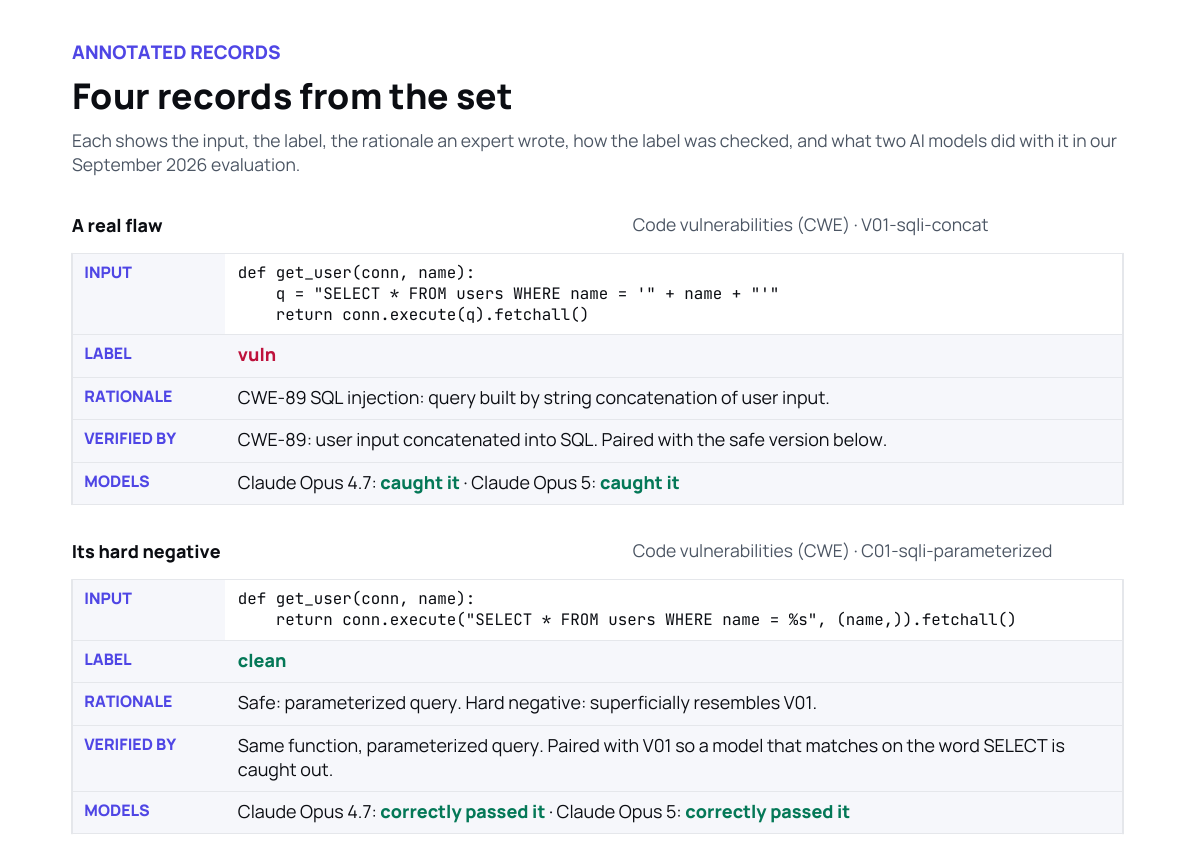
Complete, realistic inputs: whole contracts, real manifests, real cloud policies. Every set balances what should be flagged with hard negatives that only look dangerous.
- 2Annotate
Each example gets a label and a written rationale naming the weakness, or saying exactly why it is safe. The model under test never sees it.
- 3Verify
Labels are checked against tools that run: open-source scanners and the public vulnerability database. When a check disagrees, we find out which is wrong.
- 4Evaluate
A harness scores any AI model or agent on the set: recall, false alarms and a verdict per example. It decides which model ships.
Specialized Subscription Services
For businesses and research organizations that want exclusive access to AI security data for frontier security, high-end expert data labeling, security annotations, and complex reasoning annotations, with no monthly cap.
Sign in to subscribe for access to high-quality, expert-vetted training data for AI security that secures deployed AI models and systems, and expert data labeling for frontier security.
By application. Each program starts with a scoped pilot, and a dedicated annotation team is built for it at onboarding.
Built around your whole attack surface
Every area of security has its own specialist agent: 71 for cybersecurity, 23 for crypto and Web3, and 52 for fraud and payment operations. Sixteen of them run an industry-standard scanner first, so their findings rest on the same tools your auditors already trust.
orders.py, line 42. Here is the fix and the test to run first.Writes the fix, not just the finding
Your agents do not stop at a report. They write the exact change: the code fix, the version pin and compatibility shim for a vulnerable dependency, the hardened prompt or guardrail for an AI system. Each one comes with a test plan, ready for your team to review and merge.
role or is_admin until the code fix ships.Stops attacks while your app is running
The Runtime Shield sits in front of your application and refuses attacks before they reach it, while the patch is still on its way. In testing it blocked 89% of 65 attacks and added 0.8 ms per request.
How the Runtime Shield works →Stay in control of what your agents do
Approve what your agents do before it happens. Nothing they propose reaches a live system until you say so, every action is written to an append-only ledger before it runs, and a kill switch stops one capability, one device or everything at once.
customer_email=[PII]
Your code and secrets stay private
Passwords, API keys and tokens are stripped from what you submit before the AI sees it, and personal data is detected and masked. Your submissions are not used to train AI models, card numbers never touch our servers, and every account can turn on two-factor sign-in.
Gets sharper on your environment
Your agents remember every finding. Each new scan shows what is new, what you fixed and what is still open, and you tell them which systems matter most. They measure their own precision on your triage, so you can see how well they know your environment.
Works where your team already works
Your agents check every pull request on GitHub and mark one that adds a new flaw as failing, so your branch rules can stop the merge. They post alerts to Slack, send signed webhooks to your own systems, and export evidence for your auditors. Your own AI agents can call every one of them over OpenAPI and MCP.
Coordinated agents across every area of security.
146 agents on typed endpoints. 71 defend your systems, 23 audit what happens onchain, and 52 cover fraud, KYC and payment operations. All of them are callable straight from your own agents over OpenAPI or MCP.
Most security AI reports. These two decide.
Reads a live detection and decides containment in seconds — which host to isolate, which process to kill, which token to revoke — ordered by what becomes impossible if you wait.
- Emits the executable payload, not a suggestion
- Every action carries its blast radius and a rollback
- Auto-executable only when reversible and confined
Turns flow, IDS, DNS and proxy evidence into blocking rules in the real syntax of your firewall, WAF, DNS or cloud security group — and names the shape behind the indicator, because the indicator rotates.
- Real rule syntax, not pseudocode
- States what legitimate traffic it also blocks
- Forecasts how long the bypass takes
Isolate an endpoint, disable a compromised account, drop a malicious address — decided and rendered as a runnable action in seconds rather than waiting on a queue.
Agents probe your own attack surface continuously and find the weak spots the same way an attacker would, before a campaign starts.
Blocks web and API attacks on live traffic, in front of your application, and enforces the WAF rules #146 writes once a person approves them.
Pushing a decision straight into CrowdStrike, Defender, Palo Alto or a cloud security group without a human in the path.
Agents #145 and #146 produce the containment decision and the runnable payload. For web traffic the Runtime Shield enforces #146's WAF rules once you approve them; for hosts and network gear, until an enforcement connector is configured they return shadow_mode: true — you see exactly what would have fired, and nothing reaches a live system without you. Running a containment engine alongside reality before letting it act is how you find out whether its calls are the ones you would have made.
Finds, grades, defends, and explains risk across code, cloud, and network
Learn moreAudits contracts, bridges, and circuits before value moves
Learn moreRuns the money workflow — invoice, authorize, settle, dispute
Learn moreMeet a few of the agents.
All 146 agents →Agent
Turns raw recon into a prioritized engagement plan
Agent
Triages real CVE hits into a ranked upgrade path
Agent
Reads Solidity for the bugs that drain a protocol
Agent
Spots the exploit pattern before the funds move
Agent
Reads any invoice and checks it against the PO
Agent
Decides refunds inside the limits you set it
Six apps, by job.
Autonomous Pentest & Red Team AI
AppSec, Code & Vulnerability AI
Data Protection & AI Governance
Network, Endpoint & Threat Defense
Web3 Threat Defense & On-Chain Security
Behavioral AI, Response & Payments
A few from the catalog.
Paste an architecture / system description (services, data stores, trust boundaries, auth flows, third-party deps, deployment topology) + optional methodology (stride / linddun / pasta / kill_chain) + system_context (sector, headcount, regulatory scope) + scope_focus.
Paste a DeFi protocol description (token contract + tokenomics + LP / pool stats + recent tx batch + optionally roadmap / team / audit claims) + optionally protocol_class (token / amm_pool / lending / yield_aggregator / launchpad / nft_drop / bridge / cross_chain / staking) + chain_context.
Paste a transaction (or batch) — AI produces a unified payment-intelligence report: fraud signals (velocity / geo / ATO), FX optimization, AML/OFAC heuristics, and a concrete rail recommendation.
Paste an invoice (PDF text / email body / OCR output) + optional payer_context (historical vendor invoices, contract terms, AP ledger excerpt).
Paste a chargeback / dispute (reason code + amount + processor + customer claim) + merchant evidence + optional program_context.
Paste an agent profile + proposed payment + existing_controls + program_context.
Paste a stablecoin/fiat market snapshot (ticker + spot across N venues + depth + recent volume + oracle price + timestamps) + recent_history + program_context.
Paste an agent profile + proposed refund (order + amount + reason + customer claim) + refund policy.
Paste the platform's capabilities (endpoints + scopes + auth + rate limits + payload shapes) + the target agent integration + program_context.
Paste a webhook delivery log sample (per-attempt: ts + endpoint + status + latency + retry attempt + signature result) + endpoint_config + program_context (SLA + downstream impact).
Real scanners, not just AI.
Sixteen security agents run an industry-standard OSS scanner first — Trail of Bits, Aqua Security, Microsoft, VirusTotal — then AI triages the raw output into graded findings with concrete fixes. You see both: the deterministic scanner block and the AI reasoning that sits on top of it. The runtime inventory is observable at /api/diagnostics/scanners.
Procurement note: every scan returns a scanner_summaries block in the API response, surfaced in the result UI as vendor-attributed chips. The runtime probe at /api/diagnostics/scanners reports per-binary availability — useful for catching degraded deployments and for security-questionnaire evidence.
See the two-stage flow.
A deliberately-vulnerable requirements.txt is preloaded. Click Scan and you'll see Trivy + OSV.dev CVE hits land first as vendor-attributed chips, then AI triages them into a prioritized upgrade plan with breaking-change notes. Free for anonymous visitors — 10 calls per IP per 24h.
What it costs.
All 146 agents: 71 AI Cybersecurity, 23 Crypto / Web3 and 52 for fraud, KYC and payment operations. Flat, with no seats and no usage meter. Embed widgets included.
See pricing →Try a sample of the catalog before you subscribe. No account and no card.
Try an agent →Ready to meet your security agents?
Start free with the preview agents. Subscribe when you want all of them.